Understanding ADA Requirements for Event Spaces
July 11, 2025
Uncategorized
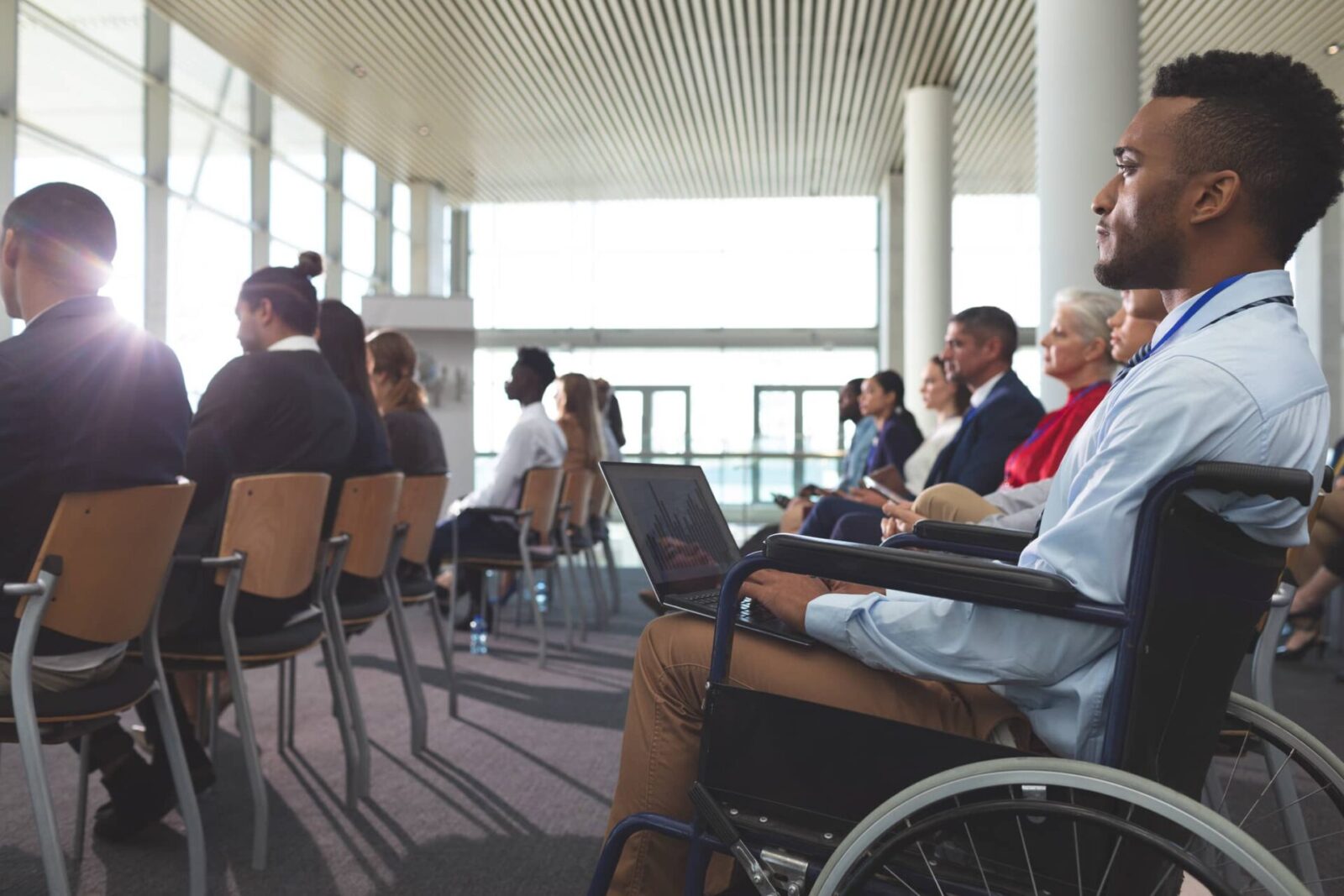
Chances are, you’re looking up Americans with Disabilities Act (ADA) requirements for events because you need to make sure your event meets compliance. What you might not be thinking about is how ADA requirements can actually help you get more attendees and increase their satisfaction.
It’s crucial to understand key accessibility requirements, but it’s also crucial to understand how they bolster event success. This guide will walk you through ADA requirements for events and go over best practices for implementing accessibility solutions to improve the attendee experience.
As of 2025, 12.2% of Americans live with mobility disabilities that make it harder for them to walk or climb stairs. And not all mobility disabilities are permanent – think of someone using crutches after breaking a bone.
For people with disabilities, planning to attend an event means being uncertain. They have to research accessibility information for events, and if that information isn’t easily found online, they have to contact the venue. If the venue isn’t accessible enough, their satisfaction with the event will plummet, and in worst-case scenarios, they won’t be able to attend at all.
Ultimately, accessibility is about ensuring that as many people as possible can enjoy your events.
Our accessibility checklist for events is a handy way to understand the major ADA requirements for events.
We’ve broken this checklist into two categories: physical accessibility and communication accessibility. In each category, you’ll find a summary of the main requirements and the relevant ADA sections so you can get all the info you need.
The ADA’s physical accessibility requirements ensure that individuals with disabilities can easily enter, navigate, and exit event spaces. We’ve included important rules and regulations here, but keep in mind that these can vary depending on your event space, so it’s best to familiarize yourself with the ADA to meet compliance.
Per Section 404 of the ADA, doors generally must have a clear width of at least 32 inches when opened 90 degrees. If the door opening is more than 24 inches deep, then the clear width must be at least 36 inches.
The door hardware (usually a door handle) must allow people to open the door with one hand and without “tight grasping, pinching, or twisting of the wrist.” There are additional requirements for aspects like closing speed, opening force, and door type.
Keep in mind that select NDA locations can help improve your entrance and exit accessibility through door widening services and automatic door openers. Our team of experts will ensure all adjustments meet ADA requirements
All accessible pathways should be continuous and unobstructed. This often means utilizing accessibility products like commercial ramps both inside and outside.
ADA Section 402 states that accessible routes may consist of walking surfaces with a slope no steeper than 1:20, doorways, ramps, curb ramps, and platform lifts. Accessible routes outside a venue must connect parking spaces to accessible entrances.
For entrances and exits that are regularly accessible only by stairs, you may need to install mobility solutions like vertical platform lifts for people who use wheelchairs or walkers.
The ADA requires not only accessible parking spaces but also accessible aisles to allow for people with disabilities to easily enter and exit their vehicles. These access aisles must be the same length as – and level with – the parking space. They must also be clearly marked.
According to ADA Section 502, compliant parking spaces need to be at least 96 inches wide. Spaces should also have firm, slip-resistant surfaces and have signage at least 60 inches above the ground. You can find more details on the ADA website.
Event spaces must have accessible seating that’s wide enough to accommodate wheelchairs. As stated in ADA Section 802, a single wheelchair space must be at least 36 inches wide, and side-by-side wheelchair spaces must be at least 33 inches wide each. Wheelchair space depth varies depending on how the space can be entered.
The ADA also has specific regulations for ticketed seats, namely that accessible seats need to be sold in the same manner as all other seats, and vendors cannot charge more for accessible seats.
Restroom regulations depend on whether the room contains a toilet and/or bath. Accessible toilets need to be between 17 and 19 inches above the floor with flush controls on the open side. Stalls should be at least 60 inches wide. ADA Section 213 and ADA Section 603 both contain more information about restrooms.
Accessible elevators must be at least 68 inches wide by 51 inches deep (or 80 inches wide if the doors are center-opening). There must also be accessible panels with tactile characters and braille as outlined in ADA Section 407.
Communication accessibility includes audio and visual aids for people with vision or speech impairments. (The ADA’s page on effective communication goes into more detail.)
For people who are Deaf or hard of hearing, venues must provide accessibility services like a qualified American Sign Language interpreter, assistive listening devices, written materials, or captioning.
The ADA requires accessibility signage to be posted in specific places, like parking spaces and elevators. Typically, the signage must feature both visual and tactile characters and be mounted at a certain height. The exact regulations vary depending on the type of signage. All accessibility language for events should be clearly written and visible, and you can also consider an accessibility statement for events to compile that information for attendees.
ADA requirements for events are best understood by taking a look at the sections that apply to your event space. Alternatively, your local Next Day Access team can provide you with a free, personalized evaluation so you can completely eliminate the guesswork. With nearly 30 years of experience as a mobility equipment supplier, we’ll make sure your venue is fully equipped to accommodate each and every one of your attendees.
Schedule a consultation and contact us today – we’ll take it from there!
Reach out to a location near you today for a custom quote!
Contact Next Day Access today for reliable mobility solutions backed by responsive, expert installation. Enter your ZIP code or postal code to find a location near you and take the first step toward a safer, more accessible space.
Reach out to a location near you today for a custom quote!
Contact Next Day Access today for reliable mobility solutions backed by responsive, expert installation. Enter your ZIP code or postal code to find a location near you and take the first step toward a safer, more accessible space.